
A video can explain the controls. It cannot give you machine feel, jobsite judgment, or supervised correction.
By Andrew McLoughlin
Vice President of Admissions & Operations
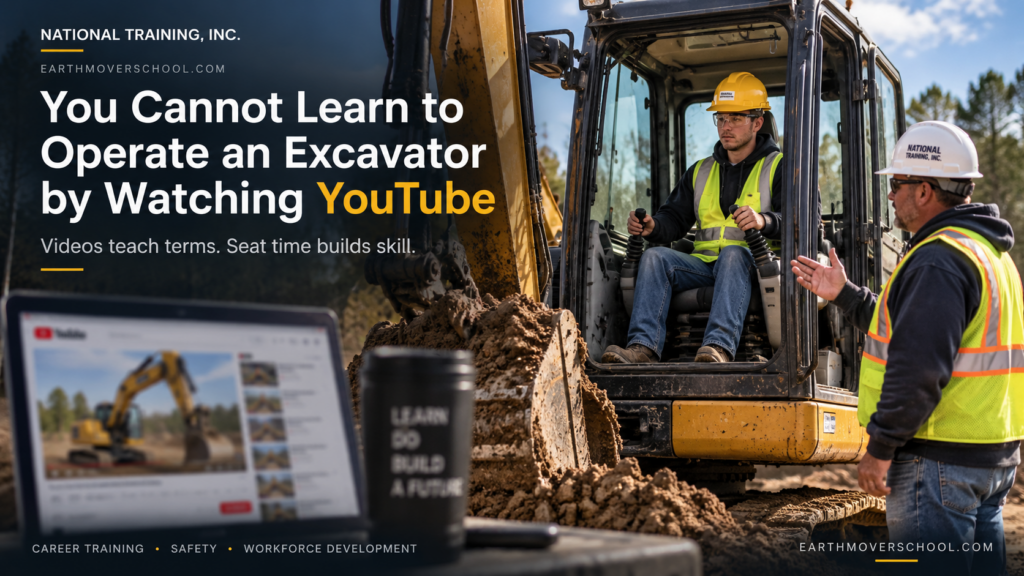
Online video can explain excavator controls; supervised machine time develops feel, judgment, and safe operating habits.
YouTube can show a perfect trench in twelve minutes. It usually leaves out the hours of practice, corrections, setup, inspections, ground conditions, and mistakes that came before it.
Online videos are useful. They can introduce terminology, show a walk-around, explain control patterns, demonstrate a work cycle, and help a student visualize an unfamiliar task. A good video can make classroom instruction more understandable.
But watching an excavator operate and operating one safely are not the same activity.
The machine talks back
An operator learns through sound, vibration, resistance, balance, visibility, and the response of the controls. The ground may be soft, uneven, wet, compacted, or unstable. The bucket may enter material differently than expected. The machine may feel different with the boom extended, the upper structure rotated, or the tracks positioned poorly.
A screen cannot reproduce those conditions. It can only show them.
Machine feel develops when a beginner makes a movement, sees the result, receives correction, and tries again. That feedback loop is the difference between information and skill.
Blind spots are real, not theoretical
An excavator has a working radius, counterweight, boom, attachment, travel direction, and areas the operator cannot see clearly. On a real site, people, trucks, utilities, slopes, structures, and changing ground conditions create risk.
A video may tell someone to check the area before swinging. Supervised training can stop the exercise when the student forgets, explain what was missed, and require the student to reset the habit.
That correction matters. Unsafe confidence often begins when a beginner recognizes the controls and assumes recognition equals competence.
Digging is only one part of operating
A new operator must learn pre-operation inspections, safe entry and exit, machine startup and shutdown, travel, setup, communication, spoil placement, loading, basic grade awareness, attachment control, and what to do when conditions change.
The person also needs to understand that production does not excuse unsafe movement. A smooth cycle that places a worker at risk is not a successful cycle.
Videos can transfer knowledge. Only practice can begin building judgment – and only honest feedback can correct bad habits before they harden.
Where simulation fits
Simulation can be valuable between classroom instruction and the machine. It allows controlled repetition, familiarization with controls, and practice responding to selected scenarios. It can help a student arrive at the equipment with a basic mental model.
Simulation still does not replace the excavator. It does not reproduce every sightline, vibration, surface condition, attachment response, or consequence. The strongest training uses each tool for what it does well: classroom for knowledge, simulation for controlled practice, and real equipment for supervised application.
Training does not create an expert
Even meaningful hands-on training creates an entry-level foundation, not years of jobsite experience. A graduate still needs employer orientation, site-specific rules, machine-specific instruction, supervision, and time.
That may not sound as exciting as “become an operator fast,” but it is more honest. Heavy equipment does not care how confident someone feels. It responds to the inputs it receives and the conditions around it.
Watch the videos. Learn the terms. Study good operators. Then get into a structured training environment where somebody qualified can observe your decisions, stop unsafe actions, and make you repeat the basics until they begin to become habits.
That is how a beginner starts becoming an operator.
Sources
U.S. Bureau of Labor Statistics: Construction Equipment Operators