
Grade control can improve precision and reduce rework. It still depends on someone who understands the machine, material, and worksite.
By Andrew McLoughlin
Vice President of Admissions & Operations
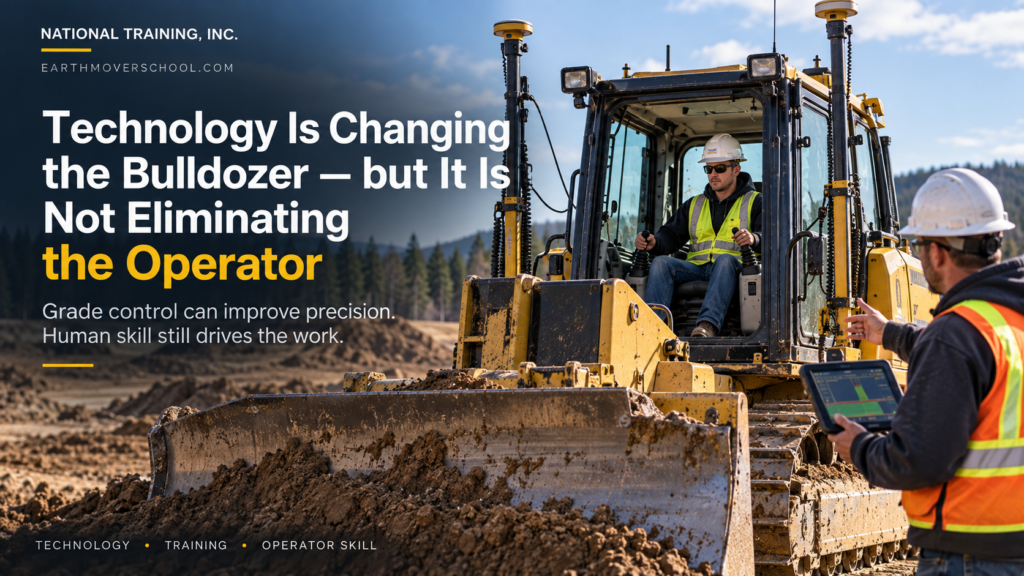
Grade-control technology can improve precision, but the operator must still understand the machine, material, design data, and conditions on the ground.
Modern bulldozers can receive design data, display elevation and slope, guide blade movement, and help operators reach grade with fewer passes. That is a major change. It is not the end of operating skill.
Grade-control platforms such as Trimble Earthworks can provide real-time guidance on elevation, slope, alignment, cut, and fill. Depending on the machine and configuration, technology can automate or assist blade control and connect field work with digital designs.
Contractors use these systems to improve accuracy, reduce rework, manage material, and support productivity. Students entering the industry should understand that this technology is becoming part of the work.
The screen does not understand the whole site
A digital model represents planned information. The operator still encounters actual soil, moisture, traction, buried surprises, changing surfaces, people, equipment, weather, and site conditions.
The operator must understand whether the machine is positioned correctly, whether the material will respond as expected, whether the work area is safe, and whether the design information matches the situation in front of the blade.
Fundamentals still matter
A person who does not understand blade control, machine balance, traction, material movement, transitions, and basic grade concepts may be able to follow a display without understanding why the result is wrong.
Technology can help a developing operator make more accurate decisions. It can also hide weak fundamentals until the system is unavailable, the setup is incorrect, or the task changes.
Grade control should make a capable operator more informed – not make an uninformed operator more confident.
Data requires judgment
Operators need to recognize what the display is showing, verify the correct design or surface is active, understand offsets and tolerances, and know when the information does not match physical conditions.
They also need to protect antennas, sensors, cables, displays, and other components; report problems; and follow the contractor’s procedures for calibration, checks, and data handling.
The technology may be sophisticated. The operator’s responsibility remains practical: move the right material to the right place without creating unacceptable risk or waste.
Training should include both worlds
Students should first understand the machine’s basic controls, inspections, visibility, and movement. They should learn how grade is discussed and how material responds. Technology can then be introduced as an additional tool.
At National Training, exposure to GPS bulldozer technology is intended to help students understand modern jobsite tools while continuing to practice foundational machine operation. The goal is not to claim mastery of every system or configuration.
Technology changes the entry-level conversation
Employers may increasingly value applicants who are comfortable learning digital tools. That does not mean a graduate should claim production-level grade-control experience after limited exposure.
A better statement is honest: the graduate has been introduced to the system, understands its basic purpose, and is prepared for employer-specific training.
The operator is still responsible
Automation can reduce repetitive corrections and support tighter tolerances. Cameras can improve visibility. Telematics can report machine data. None of these removes the operator from the safety and production equation.
The future of bulldozer operation is not human skill versus technology. It is human skill using technology with enough understanding to question it.
The strongest operators will know how to read the screen, feel the machine, understand the dirt, and stop when those sources of information do not agree.
Sources
Trimble: Earthworks Grade Control
Trimble: Machine Control Solutions
U.S. Bureau of Labor Statistics: Construction Equipment Operators