
The key may start the machine. It does not create judgment, control, production awareness, or jobsite responsibility.
By Andrew McLoughlin
Vice President of Admissions & Operations
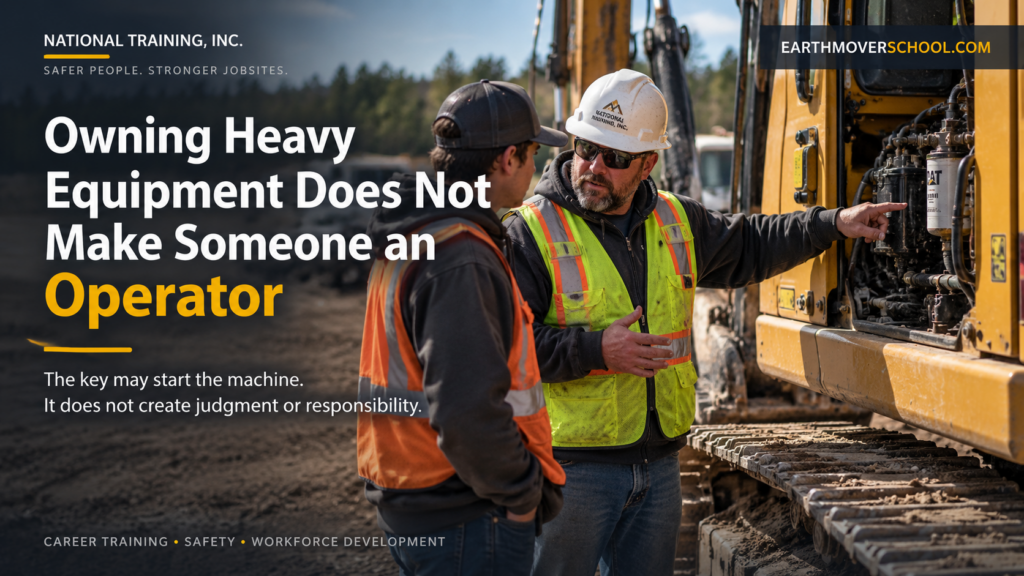
Access to a machine is not the same as competence; professional operation requires inspection, control, planning, awareness, and judgment.
Heavy equipment has become more accessible through rental companies, auctions, financing, and compact-machine ownership. Access is not the same as competence.
A person can purchase or rent an excavator, bulldozer, loader, or backhoe and begin moving material. That activity may look like operating. Professional operation involves far more than making the machine move.
Operating begins before startup
An operator needs to understand the purpose of a pre-operation inspection, recognize visible defects, check the surrounding area, use safe mounting and dismounting practices, and follow the manufacturer’s and employer’s procedures.
The machine may have hydraulic leaks, attachment problems, damaged steps, tire or track issues, warning indicators, fluid concerns, or objects inside the working area. Turning the key without looking is not efficiency.
Control is not the same as production
A beginner may learn which joystick moves the boom or how to drive forward and reverse. Productive operation requires planning the work cycle, positioning the machine, minimizing unnecessary movement, protecting the equipment, and placing material where it belongs.
A professional operator thinks about the next movement before making the current one. Speed without a plan often creates rework, fuel waste, equipment wear, and risk.
The worksite is larger than the cab
Operators must manage blind spots, swing radius, overhead and underground hazards, slopes, changing ground, traffic, workers on foot, trucks, structures, utilities, and weather. The machine’s controls do not explain which hazard matters most in the moment.
OSHA’s construction safety resources repeatedly address struck-by hazards and the dangers created when workers enter equipment blind areas. Site awareness is not an optional skill added after someone learns to move dirt.
The difference between moving a machine and operating it is the ability to control the work without losing control of the risk.
Technology does not create judgment
Cameras, sensors, grade control, telematics, and warning systems can improve information and efficiency. They do not excuse the operator from understanding the machine, maintaining awareness, and stopping when something does not look right.
A screen may show design data. It may not show the worker who stepped into a blind area or the unstable edge outside the planned cut.
Experience cannot be purchased
Structured training can provide an entry-level foundation in safety, inspections, controls, communication, and basic operating exercises. It does not produce an expert overnight.
Experience develops across different machines, materials, crews, sites, tasks, and conditions. It also develops when someone receives correction instead of repeating the same mistake with more confidence.
Employers still decide who is authorized
A school-issued certificate of completion or applicable industry credential can document training. Employers remain responsible for determining who is qualified and authorized for their machines, sites, and tasks under applicable requirements and policies.
Ownership does not bypass that responsibility. Neither does previous seat time.
The construction industry needs more people who want to learn equipment operation. It does not need more people who confuse access with mastery.
The key is only permission to start the machine. Becoming an operator requires the discipline to understand what should happen after it starts – and when it should not move at all.
Sources
OSHA Construction eTool: Struck-By Hazards
U.S. Bureau of Labor Statistics: Construction Equipment Operators