
Seat time matters, but activity without a work plan, feedback, and measurable exercises is not enough.
By Andrew McLoughlin
Vice President of Admissions & Operations
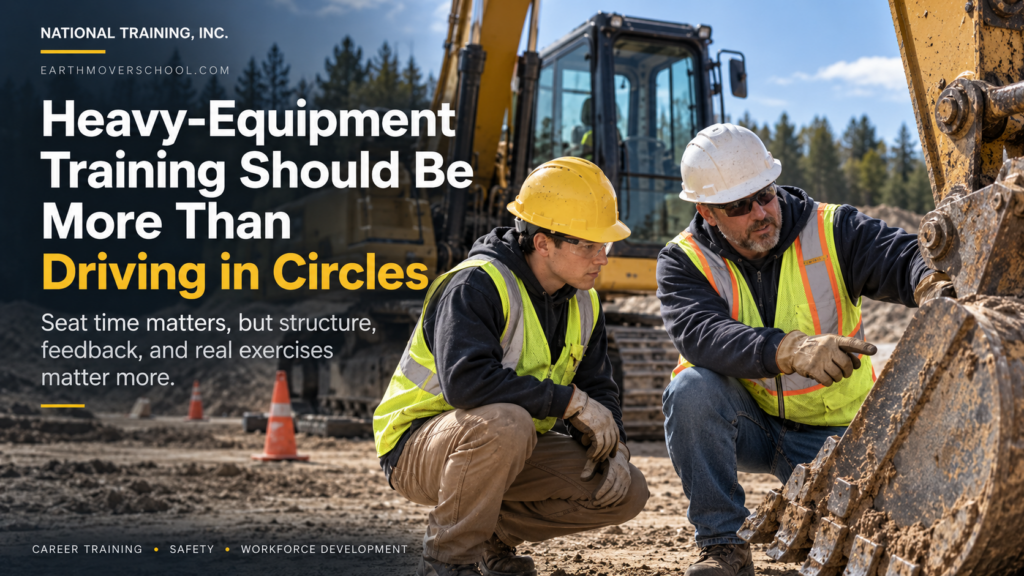
Seat time becomes training when students practice defined tasks, receive specific correction, and connect machine controls to real work concepts.
A student can spend hours in a machine and still leave without understanding how to inspect it, position it, plan a task, communicate with a spotter, or recognize a dangerous condition.
Hands-on training is essential in heavy-equipment education. It is also a phrase that can be used without explaining what the student will actually do.
The exercise should have a purpose
Driving forward, reversing, turning, and learning the controls are appropriate beginning activities. They help a student understand steering, braking, articulation, travel direction, visibility, and machine response.
They should lead somewhere. A structured program progresses toward machine-specific tasks and performance expectations rather than repeating basic movement for the sake of accumulating time.
Training starts outside the cab
Students should learn safe mounting and dismounting, pre-operation inspections, the machine’s working radius, blind spots, warning systems, startup and shutdown procedures, and communication practices.
OSHA’s construction resources show why blind areas and struck-by hazards must be understood by both operators and workers on foot. A student who only learns the controls has learned only part of the job.
Different machines require different exercises
Excavator: setup, travel orientation, swing awareness, bucket control, digging, spoil placement, trench alignment, and loading exercises appropriate to the training level.
Bulldozer: blade control, straight passes, material movement, slot awareness, transitions, basic grade concepts, traction, and smooth corrections.
Articulated wheel loader: approach, bucket position, stockpile work, travel paths, loading cycles, braking, truck interaction, and material control.
Tractor-loader-backhoe: stabilizer setup, front-loader work, rear digging controls, positioning, travel, and the transition between operating stations.
The exact exercises depend on the program, equipment, site, weather, and student level. The important point is that the training plan should connect controls to real work concepts.
Seat time has value when the student is practicing a defined skill and receiving specific correction.
Simulation has a role
Simulation can introduce control patterns, allow controlled repetition, and help students practice decisions without placing equipment or people at risk. Classroom instruction can explain terminology, safety, inspections, and job planning.
Neither replaces the machine. Actual equipment develops awareness of visibility, resistance, vibration, balance, ground response, and the consequences of movement.
Feedback separates practice from repetition
A student can repeat an inefficient or unsafe movement until it feels natural. Qualified supervision is what identifies the problem, explains the correction, and requires the student to try again.
Feedback should be specific. “Do better” is not instruction. The student needs to understand the setup, the error, the risk, and the next action.
Training creates a foundation
A short training program cannot equal years of jobsite experience, and a certificate of completion does not guarantee employment or make someone an expert.
It can produce a better-prepared beginner who understands basic safety, machine controls, communication, entry-level exercises, and the need for continued employer training and evaluation.
Students should ask to see how hands-on time is structured. Employers should ask graduates what exercises they completed, not merely how many hours they sat in a machine.
Driving in circles may be a first step. It should never be the full definition of heavy-equipment training.
Sources
OSHA Construction eTool: Struck-By Hazards
U.S. Bureau of Labor Statistics: Construction Equipment Operators