
A certificate, a registry credential, an employer qualification, and jobsite authorization are not interchangeable.
By Andrew McLoughlin
Vice President of Admissions & Operations
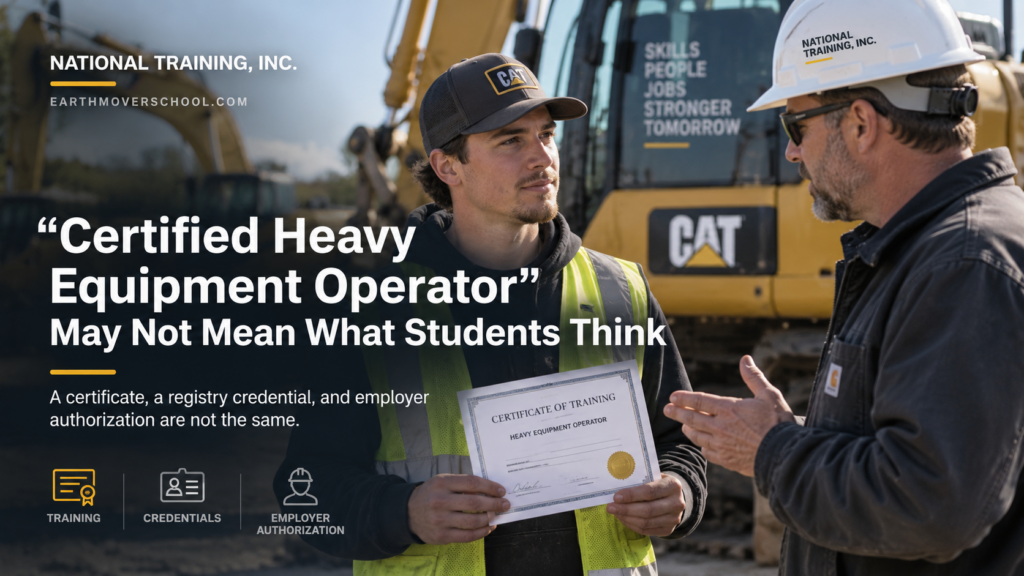
A certificate, registry credential, employer qualification, and jobsite authorization document different things and should not be treated as interchangeable.
The word “certified” sounds official, permanent, and universal. In heavy-equipment training, it can create expectations that the actual credential does not support.
Students deserve a clear explanation before enrollment. Employers deserve accurate resumes. Schools deserve standards that prevent the most aggressive advertisement from defining the market.
The solution is not to dismiss credentials. It is to name them correctly and explain what each one represents.
A school certificate of completion
A school may issue a certificate showing that a student completed a particular program and met the school’s published requirements. That document can be meaningful evidence of training. It does not automatically establish mastery, create a government-issued operator license, guarantee employment, or authorize the graduate to operate every machine on every site.
The exact program title, clock hours, completion requirements, and training components matter. A vague promise of “certification” tells the student less than a precise description of what was completed.
An industry registry credential
Some programs include curriculum or assessments connected to an industry organization such as NCCER. When applicable requirements are completed, a participant may receive credentials recorded in the organization’s registry.
That can help document specific training or assessments. It should still be described accurately. A registry credential does not erase employer requirements, site conditions, machine differences, or the need for continuing experience.
Employer qualification and authorization
Employers are responsible for deciding who may operate equipment in their operation, subject to applicable laws, safety requirements, policies, contracts, and site rules. An employer may require orientation, observation, practical evaluation, machine-specific training, refresher training, or proof of experience.
A person can complete a school program and still need to demonstrate competence to an employer. That is normal. The employer knows the actual machine, attachment, task, site, and risk.
Authorization may also be limited. Being approved to operate one machine in one setting does not necessarily mean the person is authorized to operate a different machine or perform a different task.
The honest statement is often less dramatic: training provides a foundation, credentials document what was completed, and employers decide who is qualified and authorized for the work.
Why wording matters
A student who believes a short program creates a universal operator certification may make financial and career decisions based on a false assumption. The student may arrive at an interview claiming a level of qualification the employer does not recognize. That damages trust before the conversation begins.
Schools should avoid using language that implies a government-issued license, universal certification, guaranteed job, or instant expertise unless that exact claim can be documented and applies to the program.
Better language is more specific: certificate of completion, applicable NCCER Registry credentials, entry-level training, supervised hands-on exercises, and job-placement assistance. Those phrases may not be as flashy. They are far more useful.
What students should ask
What is the exact name of the credential? Who issues it? What requirements must I complete? Will it appear in an outside registry? What does it show an employer? What does it not authorize me to do? Will an employer still evaluate or train me?
A trustworthy school should answer those questions without avoiding the limitations.
Truth protects the value of training
Career education should help people build real skills and enter opportunity with realistic expectations. Inflated credential language may increase clicks in the short term, but it weakens the value of every legitimate completion document.
A certificate can be worth earning. An industry credential can be worth documenting. Employer qualification can be worth pursuing. They simply need to be presented as what they are – not blended into one vague promise.
Students do not need bigger claims. They need accurate ones.
Sources
U.S. Bureau of Labor Statistics: Construction Equipment Operators