
Completing training documents an achievement. It does not replace jobsite experience, employer evaluation, or continued learning.
By Andrew McLoughlin
Vice President of Admissions & Operations
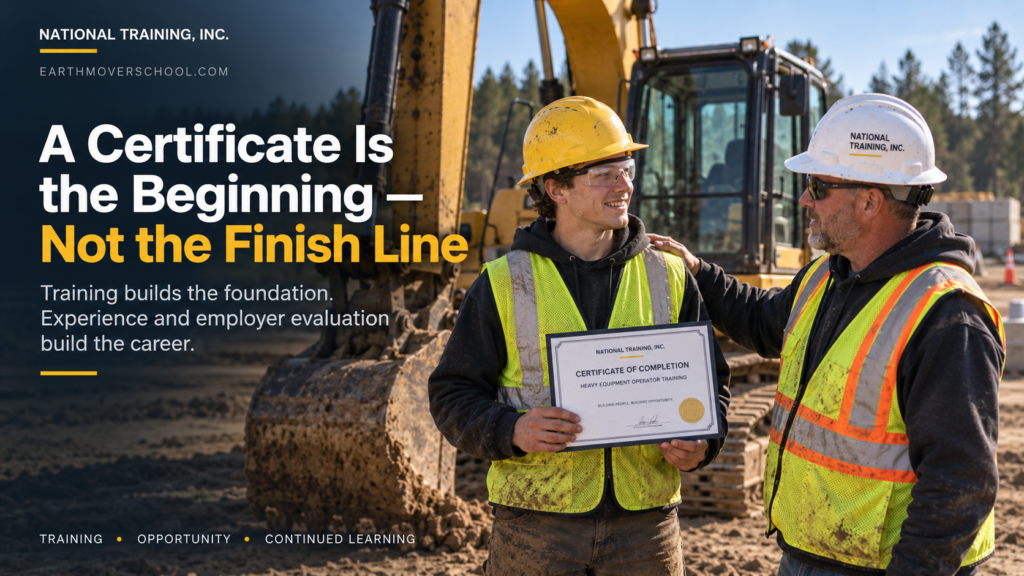
Graduation should be celebrated. It should also be understood accurately.
A heavy-equipment training certificate can show that a student completed a program and met its published requirements. Applicable NCCER Registry credentials can document specific training achievements or assessments. Those records can help a graduate explain what was completed.
They do not make the graduate a master operator, guarantee employment, or automatically authorize operation of every machine on every jobsite.
Completion proves something important
Finishing a career program often requires attendance, study, inspections, practical exercises, safety expectations, correction, and persistence. Students should be proud of that work.
Employers should not dismiss structured training as meaningless simply because it does not equal years of experience. A prepared beginner and an untrained applicant are not necessarily the same.
The credential should be described precisely
Graduates should use the exact program title and exact credential name on resumes and applications. They should be able to explain the machines, hours, classroom topics, simulation, and hands-on exercises involved without inflating their ability.
Saying “I completed entry-level training and am ready to learn your operation” creates more trust than claiming to be fully qualified for work the graduate has never performed.
A certificate can open a conversation. The graduate’s honesty, preparation, and performance determine where that conversation goes.
The employer still has work to do
Employers know the actual equipment, attachments, site conditions, production standards, traffic plans, hazards, and company procedures. They may require orientation, observation, practical evaluation, machine-specific instruction, and supervised work before authorizing a new employee.
That process is not an insult to the school or graduate. It is how general preparation becomes job-specific responsibility.
The first opportunity may not be the ideal one
A graduate may begin in a support role, on a smaller machine, performing basic tasks, or working under close supervision. The schedule, location, travel, or starting pay may differ from the long-term goal.
A reasonable first opportunity can build references, jobsite awareness, production understanding, and documented experience. Graduates should evaluate safety and fairness while remaining realistic about entry-level status.
Learning accelerates after graduation
The jobsite introduces conditions that a training environment cannot fully reproduce: different soils, weather, utilities, crews, supervisors, deadlines, breakdowns, attachments, machine sizes, and unexpected changes.
The graduate who keeps asking useful questions, performing inspections, accepting correction, and studying the work becomes more valuable over time.
Placement assistance is not placement guarantee
Schools can help with resumes, employer contacts, applications, interviews, and job leads. Graduates still need to respond, show up, communicate honestly, meet employer requirements, and perform.
No ethical school can promise that every graduate will be hired, receive a particular wage, or begin on a preferred machine.
Protect the value of the achievement
The best way to protect the value of a certificate is not to make it sound larger than it is. It is to connect the document to real training, accurate records, honest language, and continued development.
Graduation marks the point where a student can say, “I completed the foundation.” The next step is proving how that foundation supports safe, responsible growth on the job.
The certificate is worth earning. It is simply the beginning of the work.
Sources
NCCER: Credentials and Certifications
U.S. Bureau of Labor Statistics: Construction Equipment Operators