
New operators do not need false confidence. They need respect for the machine and the judgment to accept correction.
By Andrew McLoughlin
Vice President of Admissions & Operations
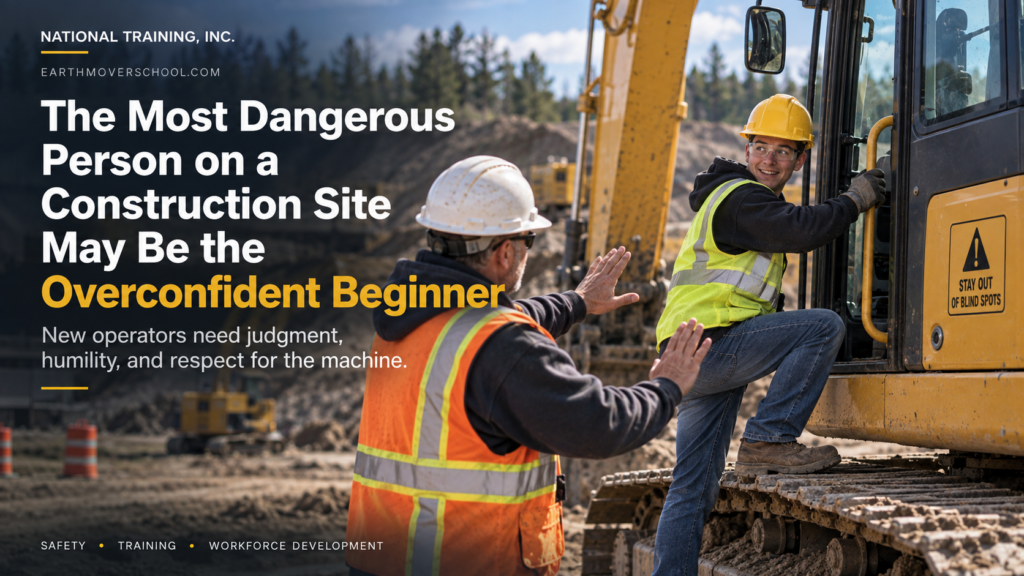
The safest beginner is not the boldest; it is the one willing to verify conditions, accept correction, and earn responsibility progressively.
A nervous beginner usually moves slowly and asks questions. An overconfident beginner may move quickly, hide uncertainty, and assume the machine will forgive the mistake.
Confidence is necessary in heavy-equipment operation. An operator cannot freeze every time a decision is required. The problem is confidence that grows faster than skill.
Recognition feels like mastery
After a few hours, a beginner may recognize the controls and complete a basic exercise. That progress feels significant because it is significant. It is not the same as being ready for every machine, task, attachment, surface, or jobsite.
The controls may remain familiar while the risk changes completely. A level training area is not a slope. Clean fill is not unstable soil. An open practice area is not a congested utility site.
Speed hides weak planning
Beginners often believe faster movement proves improvement. Experienced operators know that efficiency comes from planning, positioning, smooth control, and avoiding rework.
Rushing can cause harsh movements, material loss, poor grade, unnecessary travel, equipment wear, and reduced awareness. The beginner may complete the cycle sooner while making the entire operation less productive.
Blind spots punish assumptions
Construction equipment creates areas the operator cannot see directly. OSHA’s backover and struck-by resources emphasize the importance of understanding blind spots and keeping workers out of hazardous equipment paths.
An overconfident operator may assume the area is clear because nobody was visible a moment ago. A disciplined operator verifies, communicates, uses available systems, and stops when the situation is uncertain.
Good judgment is not knowing that you can move the machine. It is knowing when the machine should not move.
Correction is part of the skill
The beginner who argues with every correction is harder to train than the beginner who struggles with the controls. Machine control can improve with repetition. Poor attitude blocks the feedback needed for improvement.
A qualified instructor or experienced supervisor sees things the beginner does not yet recognize: positioning, sightlines, attachment angle, ground conditions, unsafe habits, and wasted movement.
Accepting correction is not weakness. It is evidence that the beginner understands the consequences.
Training should build calibrated confidence
The goal is not to make students afraid of equipment. Fear can also create unsafe hesitation and poor decisions. The goal is confidence matched to demonstrated ability.
Structured exercises should progress from inspections and basic controls to machine-specific tasks, communication, awareness, and evaluation. Students should know what they have demonstrated and what still requires supervision.
Employers should not reward bravado
Hiring managers and supervisors can unintentionally encourage overconfidence by praising speed, dismissing questions, or placing a new employee into an advanced task too quickly.
A safer entry path rewards inspections, communication, smooth control, honesty, and the willingness to stop. Production expectations should increase as ability is demonstrated.
Every experienced operator began as a beginner. The strongest ones remember that the machine does not care how confident the person in the seat feels.
The construction site needs beginners who are willing to learn, willing to speak up, and willing to earn responsibility one correct decision at a time.
Sources