
Machines do not build roads, utilities, drainage systems, or housing by themselves. Skilled people do.
By Andrew McLoughlin
Vice President of Admissions & Operations
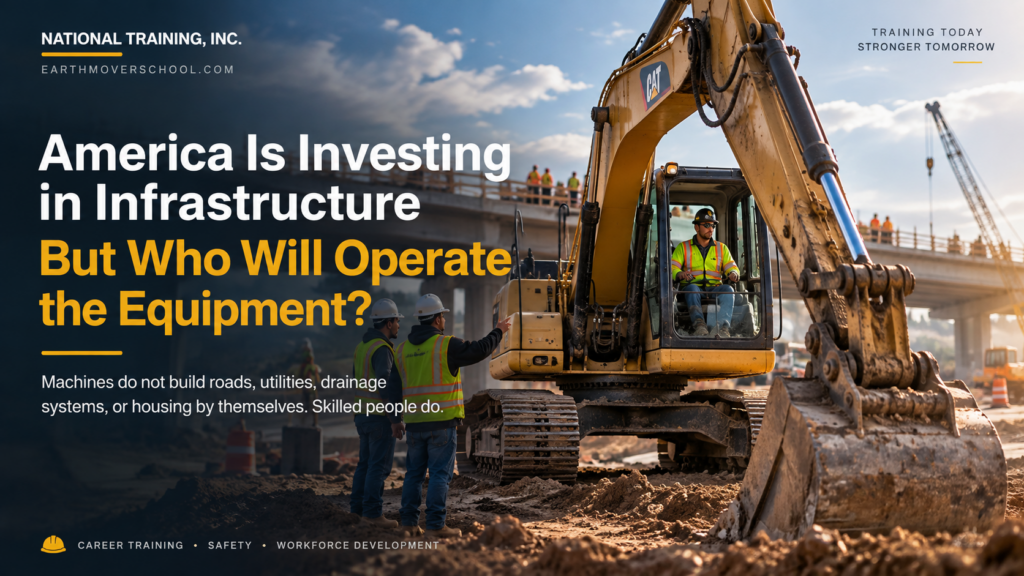
Infrastructure investment becomes completed work only when skilled operators, crews, mechanics, and supervisors are available to use the equipment safely.
A new excavator can be purchased. A prepared operator cannot be delivered with the machine.
Across the country, communities need road work, utility installation, drainage, housing, site development, bridge repair, public works, and maintenance. The equipment is visible. The workforce behind it receives far less attention.
The U.S. Bureau of Labor Statistics projects about 46,200 openings for construction equipment operators each year, on average, from 2024 through 2034. Many are expected because workers transfer to other occupations or leave the labor force. That means the challenge is not only growth. It is replacing experience that walks off the site.
Equipment investment is not workforce development
Technology has improved heavy equipment. Modern machines can provide grade information, telematics, cameras, diagnostics, improved controls, and better efficiency. Those tools matter. They do not remove the need for judgment.
Somebody must inspect the machine, understand the work plan, recognize changing conditions, communicate with the crew, protect utilities, manage blind spots, respond to weather and soil, and know when to stop.
A project can own excellent equipment and still lose time, money, and safety performance if it does not have people prepared to use it responsibly.
The workforce problem begins before the job opening
Many people do not understand the range of construction careers available. They may see an operator in a cab without seeing the planning, responsibility, and skill behind the work. Schools and employers need to show the career honestly: opportunity, physical and mental demands, schedules, travel, weather, safety expectations, and the time required to become proficient.
Overselling the career may create enrollment. It does not create retention.
Training should build prepared beginners
Entry-level heavy-equipment training should not promise instant expertise. It should provide structured instruction in safety, inspections, controls, communication, work-zone awareness, basic operating exercises, and the discipline to accept correction.
Classroom instruction can build knowledge. Simulation can allow controlled repetition. Hands-on practice can begin developing machine awareness and control. None of those elements alone is enough, and none substitutes for years of experience.
The goal is a graduate who understands the foundation and is ready for employer-specific orientation, evaluation, and continued learning.
Infrastructure funding can buy concrete, pipe, fuel, and machines. It cannot replace the experienced people who teach the next generation how to do the work safely.
Experienced operators are part of the solution
The industry’s most valuable knowledge often sits with veteran operators, foremen, mechanics, and supervisors. If that knowledge is not transferred before retirement, the loss is larger than one employee.
Employers need practical ways for experienced workers to mentor beginners without sacrificing safety or expecting the mentor to maintain full production at the same time. Schools need instructors who can explain not only what control to move, but why the work is planned a certain way.
A stronger pipeline requires coordination
Training providers, contractors, public agencies, workforce programs, high schools, veterans’ organizations, and community partners all have a role. Employers can communicate real hiring standards. Schools can align foundational exercises with entry-level needs. Funding partners can support eligible students without misrepresenting training as universally free. Students can enter with realistic expectations.
No single program will solve the workforce challenge. But fragmented efforts will continue producing the same complaints: schools say employers will not hire beginners, employers say applicants lack experience, and students say nobody told them what the first job would require.
The people are the infrastructure
We often celebrate a completed highway, housing development, utility project, or storm-recovery effort without naming the operators, laborers, truck drivers, mechanics, survey crews, and supervisors who made it possible.
Those workers are not an afterthought to the project. They are the capacity that turns investment into results.
America can budget for infrastructure. It can purchase equipment. The harder task is building a workforce that is prepared, respected, and given a responsible path from beginner to experienced professional.
That investment needs to begin before the next project is already behind schedule.
Sources
U.S. Bureau of Labor Statistics: Construction Equipment Operators
U.S. Bureau of Labor Statistics: Construction and Extraction Occupations